What to Look for in a Chicago Fishing Charter Captain
Local knowledge is the most important attribute in a fishing charter captain. Lake Michigan fish move with temperature, bait schools, and current patterns — a captain who's been running these waters for years has pattern knowledge that improves your catch probability dramatically compared to fishing blindly.
Ask about the captain's recent catch reports. Reputable charter captains maintain records and can speak honestly about what's been biting and where. A captain who promises guaranteed catches is making a promise the lake doesn't always keep — honest captains talk about probabilities and recent conditions, not guarantees.
USCG licensing is non-negotiable. Your captain must hold a valid USCG captain's license appropriate for the vessel size and passenger count. Verify this before booking — operating an unlicensed charter is illegal and dangerous.
Equipment matters. Charter boats should have properly maintained downriggers, appropriate line spreads, fresh lures, and a working live well or cooler for your catch. Ask about the vessel's current season maintenance and equipment condition.
Half-Day vs Full-Day Fishing Charters in Chicago
Half-day charters (typically 4–6 hours) are the most popular format for first-timers and small groups. They provide enough time to travel to productive water, fish multiple techniques, and return to the harbor — without requiring an all-day commitment.
Full-day charters (8+ hours) are recommended for serious anglers and groups who want maximum fishing time. More time on the water means more opportunities, and full-day trips can venture further from the harbor to find the best conditions.
For families and beginner groups, a half-day trip is usually more enjoyable — children's attention spans and adult patience for slow periods have real limits. A focused 4–5 hour half-day charter gives everyone the highlights without overstaying.
What's Included in a Chicago Fishing Charter
Most Chicago fishing charters include the vessel, captain, all fishing tackle and lures, bait, fishing licenses (confirm this — some require you to bring your own), fish cleaning at the end of the trip, and the experience of a knowledgeable guide. What's typically not included: food, beverages, personal items, and gratuity for the captain.
Gratuity for the captain and any mate is customary in the charter fishing industry — typically 15–20% of the charter fee for a good trip. Budget for this separately when planning your fishing charter expense.
Preparing for Your First Lake Michigan Charter
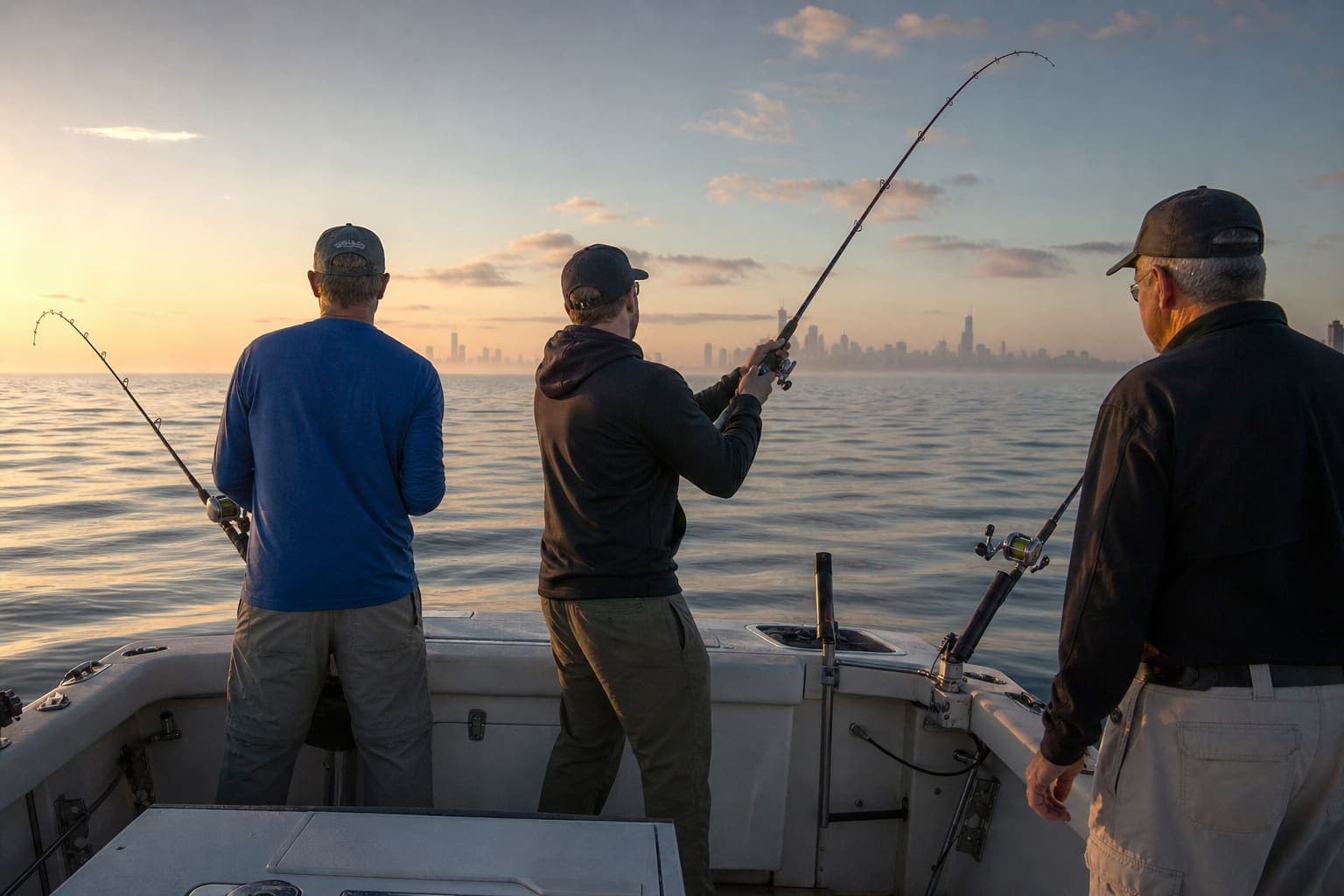
First-time fishing charter guests are often unsure what to expect on the morning of their trip. The departure time for most Lake Michigan fishing charters is early — typically 5:30–7:00am — because fish are most active in low-light conditions and captains want to be at productive water before other boats scatter the fish. This means getting to the marina before sunrise, which is logistically a different kind of commitment than most recreational experiences.
Dress warmer than you think necessary for a morning charter. Lake Michigan in the early morning — even in July — can be significantly colder than the afternoon temperature, particularly in the first hour on the water before the sun is fully up. A base layer, a mid layer, and a windproof outer shell cover every Lake Michigan morning fishing scenario. You can peel layers off as the day warms; you can't put on layers you didn't bring.
Seasickness is a real consideration for Lake Michigan fishing charters, which typically travel further offshore than recreational cruising charters and may encounter more significant wave conditions. Take an over-the-counter motion sickness medication 30–60 minutes before departure if you have any history of motion sickness. Staying in the open air and looking at the horizon rather than at the rod tip both help. Tell the captain if someone is struggling — an experienced charter captain adjusts heading and location to minimize motion when needed.
Fish Cleaning, Packing, and What to Do with Your Catch
Most Chicago fishing charter captains include basic fish cleaning as part of the charter — you arrive back at the dock and the captain or mate fillets your catch while you clean up and get organized. This service is worth confirming when booking, as some charters handle cleaning and some leave it to the angler. The filleting typically takes 10–20 minutes for a typical half-day catch and produces clean, ready-to-cook fillets.
Bringing a cooler with ice to the charter for transporting your fish home is standard practice. A medium-sized cooler with a bag of ice accommodates a typical half-day catch for 4–6 anglers. If you're traveling and need to transport fish on a flight, vacuum-sealed fillets packed in dry ice are the standard approach — some marine service businesses and fish markets near Chicago's harbors can vacuum-seal and pack fish for air travel on request.
Lake Michigan salmon and trout are excellent table fish. Coho salmon in particular is considered one of the finest eating fish in the Great Lakes — mild, rich, and versatile in preparation. Grilling, smoking, and pan-searing are all appropriate methods. Many Chicago charter guests who've caught Lake Michigan salmon for the first time express genuine surprise at the quality of the fish — the expectation gap between 'Great Lakes fish' and what they actually taste is significant and pleasant.
Understanding Catch Reports Before You Book
Current catch reports are the most reliable indicator of fishing conditions near Chicago — more so than season calendars or general species guides, which describe typical patterns but can't account for the year-to-year variability that Lake Michigan's fishery displays. Reputable charter captains post catch reports on their websites and social media accounts that reflect actual recent fishing activity. Reading these reports before booking tells you whether salmon are active at accessible depths or have moved into conditions that make a given season's fishing challenging.
The Chicago Area Charter Boat Association and similar angler organizations maintain fishery updates that give a broader picture of conditions across multiple operators. If multiple captains are reporting strong catches in a specific area or species, that's a reliable signal. If reports are quiet or captains are describing difficult conditions, that's useful information too — a good captain will tell you honestly what to expect rather than overpromising to fill their calendar.