Getting Started with Sailing in Chicago
Beginner sailing courses in Chicago typically run 1–3 days and cover the fundamentals: point of sail, basic sail trim, tacking and jibing, docking, and safety protocols. Most courses conclude with at least some time actually sailing the boat under instructor supervision. Look for ASA 101 (Basic Keelboat Sailing) courses as the standard entry-level certification.
Chicago's sailing schools operate primarily from Diversey, Belmont, and Monroe Harbor locations — all of which have direct Lake Michigan access and established sailing club infrastructure. The sailing community in Chicago is welcoming to newcomers, and many students find that the course connects them to a community of fellow sailors.
You do not need any prior experience to start a sailing course. Most schools specifically design beginner programs for people who have never stepped on a sailboat. The main prerequisites are an interest in learning and comfort being on the water.
Sailing Certifications Available in Chicago
The American Sailing Association (ASA) certification system is the standard path for American recreational sailors. ASA 101 (Basic Keelboat) is the entry point; ASA 103 (Basic Coastal Cruising) and ASA 104 (Bareboat Chartering) follow for those who want to eventually charter boats on their own.
US Sailing courses are another recognized certification path. The RYA (Royal Yachting Association) certification is recognized internationally — useful if you plan to charter in the Caribbean, Mediterranean, or other international sailing destinations.
Chicago-based sailing certification qualifies you to rent sailboats from charter companies that require a valid certification. If your goal is to eventually charter a bareboat in a sailing destination abroad, getting your ASA certifications in Chicago is a practical and beautiful way to achieve that goal.
Sailing Clubs and Community in Chicago
Chicago has an unusually active sailing club community relative to most inland cities. The Chicago Yacht Club, Columbia Yacht Club, and Chicago Corinthians Yacht Club are among the most established — each with racing programs, social events, and opportunities for new sailors to connect with the community.
Club membership is a way to access more sailing time beyond courses — crewing for club members, racing programs, and social sails give you hours on the water that accelerate skill development faster than classroom time alone. Many beginners find their way to club membership through introductory sailing courses.
Racing is not required — many club members sail purely for recreation. But for those who catch the racing bug, Chicago's racing calendar on Lake Michigan is active from late spring through fall, offering everything from casual beer-can races to more serious offshore events.
What Lake Michigan Teaches Sailors That Other Waters Don't
Learning to sail on Lake Michigan gives you something that protected bay sailing doesn't: the experience of real open-water conditions without tides or saltwater complexity. Lake Michigan's weather is dynamic — fronts move through with genuine speed, wind shifts are frequent, and conditions that start calm in the morning can develop into challenging sailing by afternoon. This variability produces sailors who learn to read the sky and make prudent decisions under uncertainty.
The lake's wave pattern differs from ocean sailing. Without tidal influence, Lake Michigan waves are entirely wind-generated and can be steep and closely spaced in a following sea — a pattern that requires different helmsmanship than the longer ocean swells that offshore sailors experience. Chicago-trained sailors who take their skills to coastal or offshore environments often find that their lake experience has prepared them well for the technical demands of tidal waters.
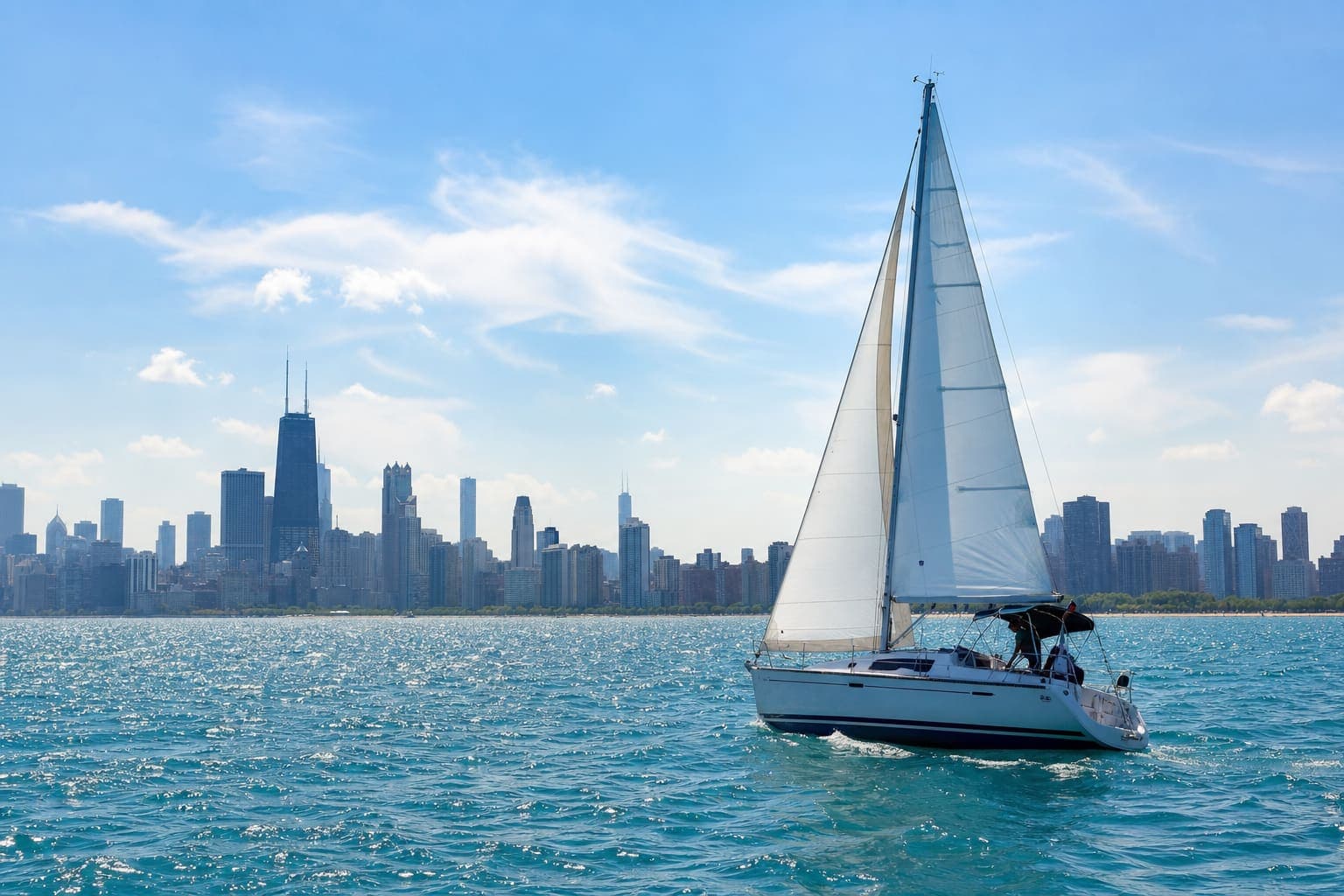
Navigation on Lake Michigan near Chicago is manageable by most standards — the city skyline is an unmistakable waypoint, and harbor entrances are well-marked. But fog, rain, and reduced visibility require proper compass navigation and VHF radio awareness that are core skills in any sailing education. Students who complete their Chicago sailing certification have these skills ingrained from the start of their sailing life.
Turning Your Sailing Education into Regular Time on the Water
The gap between completing a sailing course and actually sailing regularly is where many aspiring sailors get stuck. The most effective bridge is crewing — finding experienced sailors who need reliable crew for Wednesday evening racing or weekend sails. Most Chicago sailing clubs actively welcome new crew members, and the easiest way to find opportunities is to attend club events, ask instructors directly, or post on club bulletin boards.
Joining a sailing club offers access to racing programs, which provide a structured context for applying sailing skills in a competitive but low-pressure setting. Chicago's Wednesday evening 'beer-can' racing series at several harbors is designed to be fun rather than intensely competitive — these events give new sailors real racing experience while keeping the atmosphere social and approachable for anyone willing to show up and learn.
For those who eventually want to charter independently, the path from ASA 101 through 103 and 104 is clear and achievable in a single Chicago boating season if you're motivated. Many sailors complete their full certification stack within their first active sailing summer — and arrive at Labor Day with credentials that allow them to charter sailboats internationally the following year.
Online Learning and Off-Season Sailing Preparation
Winter in Chicago is an excellent time to advance your sailing knowledge through online coursework and study materials. ASA-affiliated schools often offer online theory courses that cover nautical rules of the road, weather, chart reading, and sail trim theory — completing this coursework before your on-water instruction begins accelerates learning significantly. Students who arrive at their first on-water lesson having studied the theory can focus entirely on the physical skills rather than splitting attention between concepts and practice.
Sailing simulation software and virtual training tools have improved significantly and can provide a meaningful supplement to on-water instruction. The ability to practice maneuvers, understand sail trim principles, and learn to read wind indicators in a low-stakes virtual environment translates more directly to on-water performance than most beginners expect. Combined with the specific knowledge of Lake Michigan conditions that classroom and on-water instruction provides, pre-season study gives new sailors a meaningful head start.